Jakob Russell · 2 September 2026
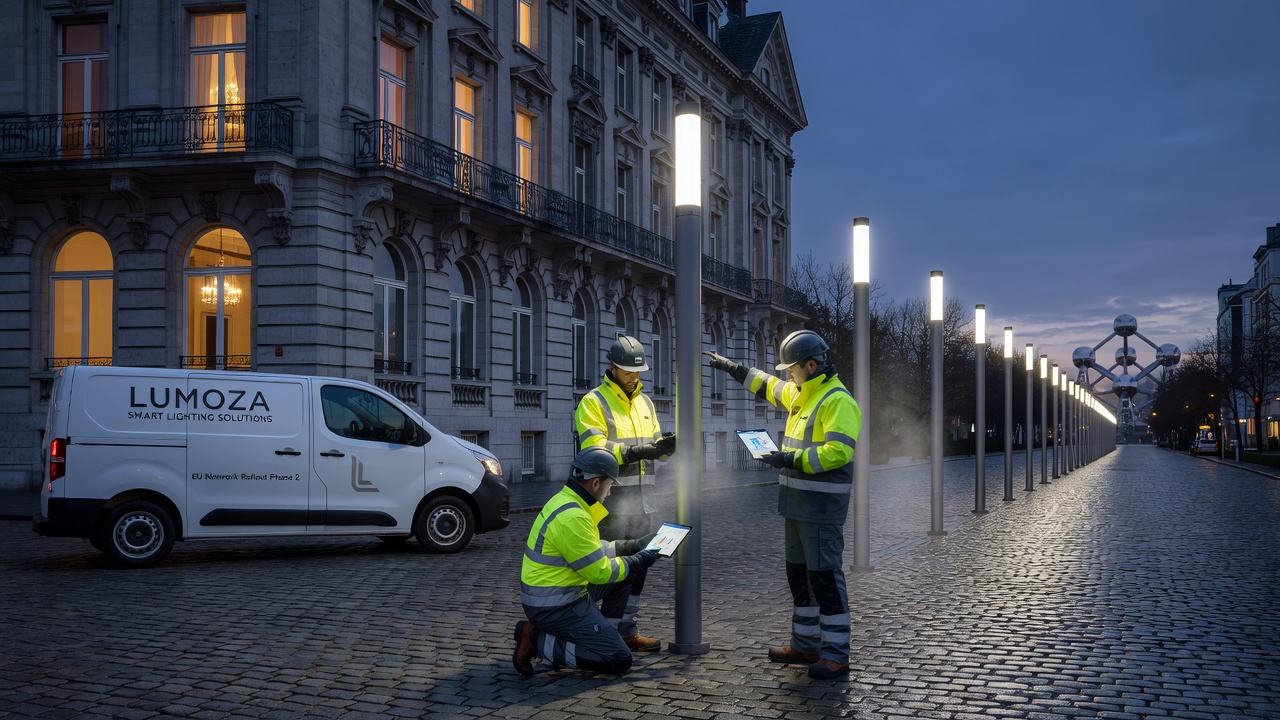
Lumoza has initiated a pilot programme deploying an advanced smart-lighting network in three European Union capitals. The project integrates LED luminaires with embedded sensors and wireless connectivity to optimise energy use, enhance public safety and gather urban data. Officials selected Brussels, Amsterdam and Vienna for the initial rollout due to their existing smart-city infrastructure and commitment to sustainability targets.
Implementation Across Pilot Cities
In Brussels the network covers key districts around the European Quarter, with 2,800 luminaires equipped to adjust brightness based on pedestrian and vehicle movement. Amsterdam focuses on the canal ring and central business areas, installing 3,100 units that integrate with existing traffic-management systems. Vienna has deployed 2,500 lights along major boulevards and parks, linking them to air-quality monitors. All installations use a common open protocol allowing real-time control from a central platform operated by municipal authorities and Lumoza engineers. The pilot phase runs for 18 months, during which performance metrics on energy savings, maintenance intervals and public feedback will be collected.
Technical specifications include adaptive dimming from 10 to 100 percent, motion detection with a 30-metre range and encrypted data transmission compliant with EU cybersecurity standards. Power consumption is projected to fall by up to 65 percent compared with conventional street lighting. Additional sensors measure temperature, humidity and noise levels, feeding anonymised datasets to city planners for transport and environmental policy development.
Expected Benefits and Next Steps
Project coordinators anticipate annual electricity savings exceeding 4.2 gigawatt-hours across the three cities, equivalent to the consumption of roughly 1,200 households. Reduced light pollution and improved visibility are expected to lower road incidents by 12 percent in monitored zones. Data insights may also support dynamic waste-collection routes and emergency-response coordination. Lumoza will publish quarterly progress reports and conduct independent audits to verify results against EU green-deal benchmarks.
Following evaluation, the initiative may expand to additional member states. Municipal partners have already expressed interest in scaling the technology to residential neighbourhoods and industrial zones. Training programmes for local technicians are underway to ensure long-term maintenance capacity. The pilot underscores growing cooperation between technology providers and public administrations in advancing climate-neutral urban environments by 2050.